Web Application Development
A website is usually a simple page or a group of pages. However, modern websites are much more complex. It has a nice interface, when open onced, looks very much like a desktop software like Microsoft Office. Such complex websites are often termed web applications. A web developer today is expected to know how to create and work with web applications. Having said that, most people use the terms interchangeably, so do not get too hung up on the terminology!
A web developer is at heart an interactive artist. They're someone driven by a deep desire to create things. A web developer's canvas is a user's web browser.
A web developer's job is to use the basic building blocks of the web (like HTML, CSS and JavaScript) to create something complex like a webpage.
There are different types of web developers who focus on different areas. These include:
- Frontend Developers: Frontend developers implement web page designs using HTML and CSS. They make sure the website looks pretty on different devices, and that the forms and buttons work.
- Backend Developers: Backend developers create the backbone of the web application. They write code logic that handles a user's input (for example, what should happen when you click the signup button after filling in a form).
- Full-Stack Developers: Full stack developers do bits of both backend and frontend. Depending on the problem at hand, they can switch cape 🦸♀️🦸♂️ and move stacks.You can learn more about the differences between frontend and backend development via FlexyCode Team
There are many other specific roles in web development, like system architects, AI, machine learning and security engineers. These roles require more specialized knowledge of one or more of the above types of development, so many professionals in these roles will start by gaining some general web development experience.
What does it take to become a web developer? Essentially, just three things: HTML, CSS and JavaScript—the three pillars of the web. Together, these three pillars make every website work, defining the content to be displayed (HTML), telling a browser how to display that content (CSS), and making the content interactive (JavaScript), respectively.
Mobile Application Development
Mobile application development is the set of processes and procedures involved in writing software for small, wireless computing devices, such as smartphones and other hand-held devices.
Like web application development, mobile application development has its roots in more traditional software development. One critical difference, however, is that mobile apps are often written specifically to take advantage of the unique features of a particular mobile device. For example, a gaming app might be written to take advantage of the iPhone's accelerometer or a mobile health app might be written to take advantage of a smartwatch's temperature sensor.
Today, the two most prominent mobile platforms are iOS from Apple and Android from Google. Phones and tablets from Apple come preloaded with essential applications, including a full web browser and the Apple App Store. Android devices also come preloaded with similar apps and you can install more using the Google Play Store.
Before developing an app, you need to determine which type you'll be creating. Here's a breakdown of several types of mobile app development technologies with information about each.
- Native applications.These applications are built using integrated development environments (IDEs) and languages for mobile OSes such as Apple iOS or Google Android. Native apps enable you to customize necessary features, but they can be more costly than other technologies.
- Hybrid apps. These are web apps that act like native apps. They are developed using technologies such as HTML, JavaScript and Cascading Style Sheets (CSS). Hybrid apps are more cost-effective to develop than native apps and can be created faster, but they aren't as feature-rich as native applications.
- Progressive web apps. A PWA is a website that looks and behaves as if it is a mobile app. These applications are developed with web technologies such as Facebook React.
- Encapsulated apps. An encapsulated app runs within a container app. Products such as the Microsoft Power App drag-and-drop app creation tool enable less experienced developers to build a mobile application rapidly. But the lack of isolation from the core OS, OS lock-in and the relative newness could pose problems.
- Frameworks and libraries. You can use this reusable code written by someone else to accelerate your development of a mobile app.
Enterprise Application Development
Enterprise application is designed to integrate computer systems that run all the operation phases of an enterprise to offer coordination and cooperation of work throughout the enterprise. Enterprise applications aim to integrate core processes of business like accounting, finance, sales, inventory, human resources, and services.
The ideal enterprise application system can overlook and control all processes in real-time through a software architecture on a client/server platform. Enterprise applications can help businesses in expanding their scope by linking them with business partners, suppliers, and customers.
Enterprise application development is the process of building and deploying a scalable application for large organizations to help facilitate their business needs. The purpose of enterprise application is to eliminate pain points and allow clients, employees, and partners to engage in the most effective way possible.
Enterprise application automates functionality and workflow to empower users to complete their desired tasks in less time. While developing the enterprise application, agility, speed and scalability are crucial. That is primarily enabled by the adoption of cloud technologies.
Enterprise applications can be divided by their business functions. Each enterprise application type can be considered a “system” as they integrate with the organization's business processes.
- Enterprise Resource Planning (ERP) - which covers Accounting, Customer Services, Procurement, Human Resource, Corporate performance and governance, Sales, Production, Distribution
- Low-code Development Platforms (LCDP)
- Business Intelligence (BI)
- Business Process Management (BPM)
- Content Management System (CMS)
- Customer Relationship Management (CRM)
- Database Management System (DBMS) - like Data Warehousing (DW, DWH or EDW) and Master Data Management (MDM)
- Enterprise Asset Management (EAM)
- Human Resource Management (HRM)
- Knowledge Management (KM)
- Networking and Information Security:
- Intrusion Detection Prevention (IDS)
- Software-Defined Networking (SDN) - consisting of SD-WAN
- Security Information Event Management (SIEM)
- Product Data Management (PDM)
- Product Information Management (PIM)
- Product Lifecycle Management (PLM)
- Supply Chain Management (SCM)
- Software Configuration Management (SCM) like Version Control System (VCS)
UI Design
The user interface (UI) is the space where interactions between humans and machines occur. UI is an integral aspect of user experience (UX) that consists of two major parts: visual design, which conveys the look and feel of a product; and interaction design, which is the functional and logical organization of elements. The goal of user interface design is to create a user interface that makes it easy, efficient, and enjoyable for users to interact with a product. Learn about the different types of UI as well as fundamental design requirements for each type.
UI design prioritizes the user's visual experience. A good user interface is functional, reliable, and enjoyable to use. User interface design should minimize the effort that the user has to invest interacting with a product and help users accomplish their goals with ease.
Designers use methods of user-centered design (user interviews, direct observations, etc.) to learn about their target audience and ensure that the visual language they introduce in the UI is well-tailored to them. It's important to make the UI aesthetically pleasing because interfaces that have great aesthetics are perceived as more usable by end-users, according to the aesthetic-usability effect.
Good UI design is critical to a product's success. Without it, users may find a product to be unusable. Most designers follow a set of user interface design principles to guide their designs and ensure their products are successful.
The most important elements of UI design are:
- Place users in control of the interface
- Make it comfortable to interact with a product
- Reduce cognitive load
- Make user interfaces consistent
Quality Assurance & Automation
Every piece of software needs to be tested rigorously before it reaches the market. To do otherwise would be to risk anything from minor bugs to major security vulnerabilities. But the pressure is on to bring software to market faster than ever, and to release more frequent updates to your web and mobile apps to keep up with customer demand.
That's why many companies rely on quality assurance (QA) automation to continually test their software more effectively and more frequently than manual testers can.
QA automation refers to using a separate piece of software to run tests on the software that you're developing. In the past, human testers would have to perform many of these tasks themselves, with the aid of some technology to reduce repetition.
But automated testing can handle many of these tasks entirely, and can even perform more advanced tests that aren't possible to do by hand.
There are several ways to incorporate QA automation into your company, including:
- Developing tests from scratch with your in-house development team
- Using codeless test automation software designed for non-coders
- Outsourcing your tests to a third-party QA service
Automated QA testing is important for companies that practice continuous integration, which means that software is developed, tested, and deployed multiple times per day, rather than in stages, as was common in more traditional development models.
Software testing is used to detect serious bugs and security vulnerabilities, as well as user experience issues, such as glitches that only appear in specific use cases.
Reseach & Development
Research and development (R&D) includes activities that companies undertake to innovate and introduce new products and services. It is often the first stage in the development process. The goal is typically to take new products and services to market and add to the company's bottom line.
KEYTAKEAWAYS
- R&D represents the activities companies undertake to innovate and introduce new products and services or to improve their existing offerings.
- R&D allows a company to stay ahead of its competition by catering to new wants or needs in the market
- Companies in different sectors and industries conduct R&D—pharmaceuticals, semiconductors, and technology companies generally spend the most.
- R&D is often a broad approach to exploratory advancement, while applied research is more geared towards researching a more narrow scope.
- The accounting for treatment for R&D costs can materially impact a company's income statement and balance sheet.
The term R&D is widely linked to innovation both in the corporate and government sectors. R&D allows a company to stay ahead of its competition. Without an R&D program, a company may not survive on its own and may have to rely on other ways to innovate such as engaging in mergers and acquisitions (M&A) or partnerships. Through R&D, companies can design new products and improve their existing offerings
R&D is separate from most operational activities performed by a corporation. The research and/or development is typically not performed with the expectation of immediate profit. Instead, it is expected to contribute to the long-term profitability of a company. R&D may lead to patents, copyrights, and trademarks as discoveries are made and products created.
Companies that set up and employ entire R&D departments commit substantial capital to the effort. They must estimate the risk-adjusted return on their R&D expenditures—which inevitably involves risk of capital—because there is no immediate payoff, and the return on investment (ROI) is uncertain. As more money is invested in R&D, the level of capital risk increases. Other companies may choose to outsource their R&D for a variety of reasons including size and cost.
Business Consultation
A business consultant is a professional that works with clients on a variety of aspects intending to help to improve, grow, or maintain a company. Learn more about business consultants, what they can provide, and more in this guide. A business consultant is an individual who works closely with business owners and managers to improve operations and efficiency. Business consulting includes helping to identify, address, and overcome obstacles to meet the company's goals.
Business consultants can assist in nearly any need your business might have. There are business consultants that specialize in specific industries, while others take a more general approach. While specific services vary, some of the most common ones are listed below.
- Identify obstacles that are preventing growth or efficiency
- Determine what changes need to be made and help implement changes
- Provide any necessary training and resources to staff and management
- Bring out-of-the-box ideas to refresh a business
- Assist in business planning and creating new businesses
- Assess, hire, and fire staff, if necessary
- Implement new programs
- Analyze a company's budget, suggest adjustments, and help put those adjustments in place
- Locate providers and partners to help meet goals
Being a business consultant requires a lot of planning, researching, and organization. Using the right tools to support your business can provide many benefits. Some of the most important tools business consultants use are listed below.
- CRM Software
- Proposal Software
- Project Management Tools
- Time-Tracking Tool
- Cloud Automation Software
Digital Marketing
The term digital marketing refers to the use of digital channels to market products and services in order to reach consumers. This type of marketing involves the use of websites, mobile devices, social media, search engines, and other similar channels. Digital marketing became popular with the advent of the internet in the 1990s.
Digital marketing involves some of the same principles as traditional marketing and is often considered a new way for companies to approach consumers and understand their behavior. Companies often combine traditional and digital marketing techniques in their strategies. But it comes with its own set of challenges, including implicit bias.
KEY TAKEAWAYS
- Digital marketing involves marketing to consumers through any number of digital channels, including websites, mobile devices, and social media platforms.
- This form of marketing is different from internet marketing, which is exclusively done on websites.
- Digital marketing is a broad field, including attracting customers via email, content marketing, search platforms, social media, and more.
- One of the biggest challenges digital marketers face is how to set themselves apart in a world that is oversaturated with digital marketing ads.
- Digital marketing comes with various challenges, including implicit bias.
Types of Digital Marketing Channels
- Website Marketing
- Pay-Per-Click Advertising
- Content Marketing
- Email Marketing
- Social Media Marketing
- Affiliate Marketing
- Video Marketing
- SMS Messaging
Music/Video Production & Distribution
Who are the people working on a music video production? The answer often comes down to your budget.
Large-scale productions will have many experienced professionals fulfilling specific roles. On the smallest sets, people usually have a broader scope of responsibilities to cut down on costs.
Even in the smaller productions, you will need to have:
- Director:
- Producer/Executive producer:
- Director of Photography:
- Gaffer/Chief lighting technician:
- Talent:
- Editor:
The director is essentially the person in charge, and they have the final say in most questions. This person guides the rest of the cast and crew from the start to the end of filming.
Even if you're planning a low-cost production, someone has to pay the bill. The producer oversees purchasing and the budget, making sure that everything is running smoothly.
A director of photography or DOP is in charge of everything visual on-screen, the framing, composition, lighting, and more. They often take on responsibilities during pre-production, developing the concept, scouting for the right location, and creating the storyboard.
This person takes charge of all lighting needs on set. Often accompanied by a runner or best boy, they make decisions, set up, and move around the light to achieve the director and DOP's vision.
In most cases, a music video will feature some sort of performer who will sing, act, or dance in front of the camera. The talent of the video can differ from the original artist of the song.
No video would be complete without the post-production editor. The editor works closely with the director to take the raw footage and transform it into the final edit.
TV/Radio/Paper Advertisements
If you sell a product or service, and want to be successful quickly, you must tell people about it through advertising and marketing. TV, radio and newspaper are still considered the major media for effective marketing off-line.
However, a lot has changed with these top three marketing vehicles in the past 15 years. In this article some critical changes are revealed that have occurred and how you can get the maximum impact for your advertising dollar.
Television is primarily an entertainment medium. Research shows the average person spends more time with television than with radio and newspaper combined. For many years, TV was considered the most powerful advertising choice because of the huge audience it provided. Even today, nearly everyone watches some TV every day.
There are three things you must consider before spending money on TV advertising - limited lifespan of your ad, audience fragmentation, and ad avoidance.
Keep in mind that once your ad has aired, it is gone for good. There is no way your potential customer can refer back to it. This fact makes it imperative that you run your ad many times to embed your message in the mind of the viewer. Frequency is important with any advertising, but especially broadcast.
Audience fragmentation is one of the major problems local broadcast television faces today.
Features of Radio:
Radio is one the advertising medium that helps in broadcasting. Now-a-days, it is in great demand because low income groups can also buy the radio sets. People like listening to radio as it provides all useful information like news, gossip about film stars, tips for children etc. People can hear the latest music and advertisements also. With the help of radio broadcasts, businessmen can easily reach a huge mass of people in various parts of the country to advertise their product.
Various consumer moods can be advertised on radio like movies, fans, leather items, bags, sewing machines etc. Oral messages are more impressive than the written or printed ones. It does not require education to receive the message, even though it is an audio medium. It is so because the people who are listening may not be literates. Ads can be repeated as and when required at regular intervals. Such an advertising media is suitable for mass consumption goods.
Features of Newspaper:
Newspaper is said to be a print medium and it is published on a daily basis. A positive aspect of newspaper is that the message is communicated to customers through words in print, sometimes with pictures or photographs and fakeness would not be there because message is in the written form. One should use and make the words attractive, appealing and informative. Newspapers are published regularly, widely and in various languages to be read by literate people. It is treated by many as the source that provides information. It can prove to be a good medium of advertising as it an reach a huge mass of people and even is quite cheaper than radio and television. With the help of newspapers, messages can be repeated almost everyday, if required.
Businessmen can advertise the goods of mass consumption in newspapers because they are read by the general public. A person can choose a particular newspaper from a whole lot depending on his need. To get the information about the nation, a newspaper which has nationwide circulation can be selected. For regional coverage, a newspaper in that regional language can be selected.
Features of Television:
It is mostly choose by the businessmen as a medium of mass communication in order to advertise their product. Television growth took place because of satellite transmission and establishment of more relay stations in order to capture remote areas of the country. It is said to be very effective because it provides sound, vision and movement as compared to any other medium like radio and press. Because of this reason, businessmen like TV to demonstrate their product and its advantages.
Through TV, viewers can get extensive coverage and the impact of visual communication. There are many community centers and public places in remote areas, for the poor people who cannot afford to buy TV sets. They can easily watch TV programs at such places.
To advertise a product through TV, a large amount has to be paid to advertisement agencies. One can watch many channels on TV like cartoon network, discovery channels for the children to watch, news channels, devotional channels etc. for the old ones; daily soaps, cookery Classes etc. for the ladies and fashion channels, sports and movie channels etc, for the youngsters. Goods of mass consumption can be advertised through television. Ads can be repeated on TV at regular intervals as and when required.
Influenzer Marketing
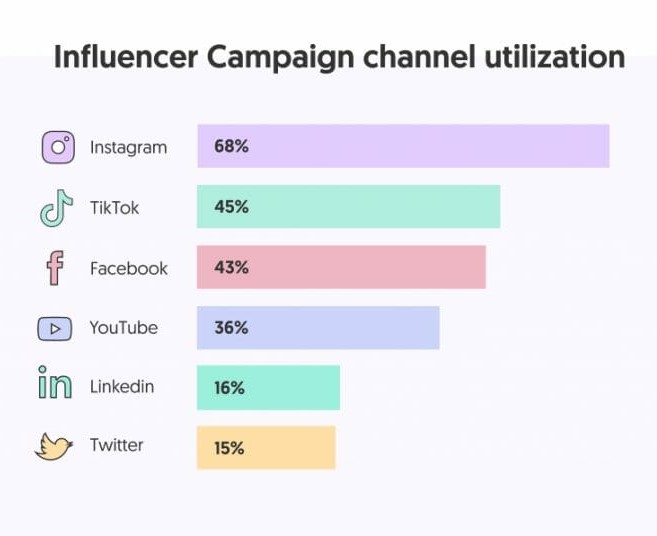
Influencer marketing is now a mainstream form of online marketing. It has been a buzzword for a while now, and the mainstream media regularly refers to it. Yet, there are still people who do not really understand what influencer marketing is all about. Indeed, some people come across the phrase for the first time and instantly ponder, "What is influencer marketing?"
The Influencer Marketing Hub is now an established website with hundreds of articles explaining the intricacies of influencer marketing, along with other types of online marketing. The original version of this post was the first article we wrote for the site. We know, however, that there are still people who come here for the first time, wondering what influencer marketing is. So, we have updated this article to focus on the basics of influencer marketing for 2023.
Influencer Marketing is a hybrid of old and new marketing tools. It takes the idea of celebrity endorsement and places it into a modern-day content-driven marketing campaign. The main differentiator in the case of influencer marketing is that the results of the campaign are collaborations between brands and influencers. But influencer marketing does not just involve celebrities. Instead, it revolves around influencers, many of whom would never consider themselves famous in an offline setting.
Graphic Designing
When you think of graphic design, do you think of artistic advertisements? Eye-grabbing graphics on websites? Stunningly arranged spreads in magazines? While these examples certainly fit under the graphic design definition, the term encompasses a lot: posters, infographics, book covers, product labels, logos, business cards, signs, website layouts, mobile apps, software interfaces—the list goes on.
So what is graphic design, exactly? Listing these graphic design examples is a good start, but it does not paint the full picture. While covering the details and intricacies of the entire graphic design field might not be possible in one article, this high-level overview will help you better understand this creative career field.
Graphic design basics
To better understand the meaning of graphic design, it is important to be aware of the elements and principles that make up design. Elements are used in conjunction or opposition with each other to create visually striking and impactful designs.These graphic design elements include:
- Color
- Form
- Line
- Shape
- Size
- Space
- Texture
Graphic designers also adhere to the principles of design, which are essentially a set of guidelines that help a design achieve effective composition. These basic principles aid in creating balance and stability for the piece of work.These graphic design principles include:
- Balance
- Contrast
- Emphasis
- Movement
- Proportion
- Rhythm
Types of graphic design
- Website design:
- User experience (UX) design
- Motion graphics design
involves creating engaging and intuitive web pages for users. This includes overall layout, color scheme and navigation.
is focused on ensuring a website or application is easy and satisfying to use. These designers emphasize value, usability, adoptability and desirability.
—or animation—brings visual elements to life through special effects, TV shows, video games and movies.